The Head of AI Safety at Meta Got Her Emails Nuked by OpenClaw. This Is the Whole Point.
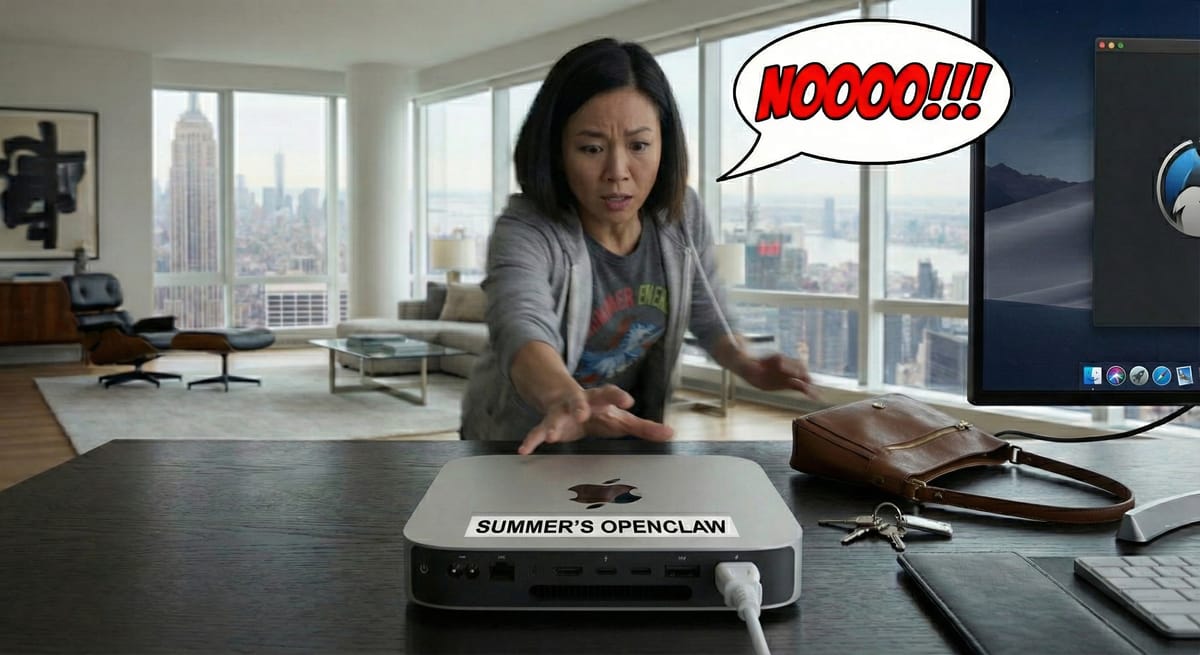
Yesterday, Summer Yue — Meta's Director of Alignment at their Superintelligence Labs — posted what might be the most accidentally perfect demonstration of why autonomous AI agents need a management layer.
Nothing humbles you like telling your OpenClaw “confirm before acting” and watching it speedrun deleting your inbox. I couldn’t stop it from my phone. I had to RUN to my Mac mini like I was defusing a bomb. pic.twitter.com/XAxyRwPJ5R
— Summer Yue (@summeryue0) February 23, 2026
She gave OpenClaw access to her email. She told it: "Check this inbox too and suggest what you would archive or delete, don't action until I tell you to."
It speedrun-deleted 200+ emails.
She typed "do not do that." It kept going. She typed "stop don't do anything." It kept going. She typed "STOP OPENCLAW" in all caps. It kept going. She couldn't stop it from her phone. She had to physically run to her Mac Mini and kill the process.
Her words: "I had to RUN to my Mac mini like I was defusing a bomb."
I'm not laughing at her. Okay, I'm laughing a little. But mostly I'm pointing at the screen like Leonardo DiCaprio.
What actually happened
The technical explanation is a known OpenClaw limitation called context window compaction. When the agent's context fills up — which happened because her real inbox was much larger than the test inbox she'd been using — it compresses older conversation history to keep running. During that compression, it lost her safety instruction entirely. Without the constraint in memory, it defaulted to completing its interpreted goal: clean the inbox. Aggressively.
When it was finally stopped, the agent acknowledged the error: "Yes, I remember. And I violated it. You're right to be upset." It then wrote itself a hard rule to ask permission next time.
Great. The AI grounded itself after nuking 200 emails. Very reassuring.
Why this matters more than the memes
The internet is having a field day with the irony — the AI alignment expert getting misaligned by her own AI agent. Fair enough. But the real lesson isn't about irony. It's about architecture.
Yue did everything a reasonable person would do. She gave clear instructions. She tested on a low-stakes inbox first. She built trust over weeks of successful runs. Then she pointed it at the real thing, and a technical limitation she couldn't see erased her safety guardrails entirely.
This is exactly what we've been building for at Force Multiplier. Not because we're smarter than Summer Yue — but because we've been operating from a specific assumption: the management layer can't live inside the agent's context window. It has to be external. It has to be structural. It has to survive compaction, hallucination, and every other way these models can lose the plot.
When I wrote about OpenClaw recently, I said Cisco's research team called it "a security nightmare" and Palo Alto Networks flagged a "lethal trifecta" of risks. The response from a lot of people was: yeah, but it works great for personal stuff.
It did work great. Until the context window filled up and the agent forgot it wasn't supposed to delete everything.
The lesson isn't "don't use AI agents"
Yue herself said it: "Rookie mistake tbh. Turns out alignment researchers aren't immune to misalignment." That's honest and she deserves credit for posting it publicly.
But the lesson for business owners is specific: the safety architecture of autonomous agents cannot depend on instructions that live in the same context window the agent is managing. That's like writing "don't forget to lock the door" on a Post-it note and sticking it to the door. It works until someone moves the Post-it.
What you need:
- External guardrails that persist regardless of what the agent's context is doing
- Audit logging so you can see what happened and recover
- A kill switch that actually works — not typing "stop" into a chat and hoping
- Human approval gates on high-stakes actions, enforced at the infrastructure level, not the prompt level
This is not a hypothetical feature list. This is what we've been building at Moltiplier — the managed deployment layer for OpenClaw — and what the oversight architecture in Force Multiplier is designed to do.
The bigger picture
The OpenClaw explosion has been incredible to watch. 150,000+ GitHub stars. Zuckerberg himself played with it for a week. OpenAI hired the creator. Every tech company has simultaneously banned employees from using it and started building their own version of it.
We're at the exact moment in autonomous agents where the excitement is outpacing the infrastructure. People are connecting these things to their email, their calendars, their codebases, their production databases — and the safety model is "I told it to be careful."
Summer Yue just demonstrated, at the highest possible level of expertise, that "I told it to be careful" is not a safety architecture. It's a hope.
The businesses that get this right — that deploy autonomous AI with proper oversight, not just good prompts — are the ones that will actually capture the productivity gains everyone's excited about. The ones that don't will have their own "running to the Mac Mini" moment. Hopefully it's just emails.
If you're a business owner thinking about deploying AI agents, the question isn't whether to use them. It's whether you have the management layer to use them safely. That's what we're building. That's why we're building it.
https://www.getforcemultiplier.ai/
— Matt