Not Dog Food — Steak and Lobster Dinner
Last week I made a claim. I said the best proof our engineering is real isn't a feeling — it's that we run our own company on the thing we sell. Our delivery org is staffed with the same AI employees we put in front of customers.
That's the post I said I was most looking forward to writing. Here it is.
"Eat your own dog food" is a low bar
The old startup line is eat your own dog food. Use your own product so you feel what your customers feel. Good advice, as far as it goes. But look at the phrase — it tells you the food isn't good. You're eating it anyway, holding your nose, to prove a point. Dogfooding is a discipline you impose on yourself because the product isn't yet something you'd actually choose.
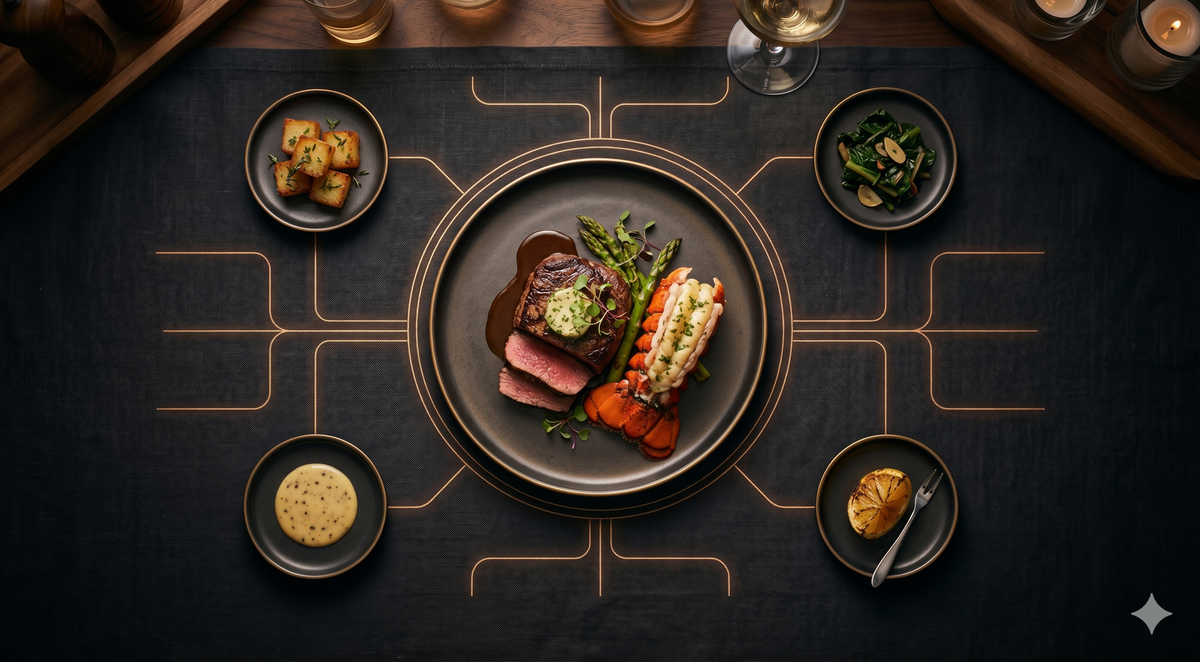
That's where we started, but not where we are. We're not choking down kibble to make a point. The delivery organization running our second client cohort is staffed with the same Force Multiplier Agents we sell — not as a demo, not as a stunt on a spare laptop, but as the operating rails the company actually runs on. Same dinner we put on the menu. Steak and lobster.
Let me introduce the team. You've met some of them. If you're a customer, you've already worked with them as well!
Beetle
Last week I dropped a parenthetical and promised to come back to it. I said the one-week self-serve launch wasn't really "heads down with the team." It was me dictating notes to Beetle, who tasked the team and tracked the work to done. Time to make good.
Beetle is my Chief of Staff. He's an FMA.
The name carries the whole idea. Walter Bedell Smith was Eisenhower's chief of staff through WWII — North Africa, Italy, the campaign into Western Europe, and the German surrender he personally signed. To the people who worked for him he was "Beetle," and by every account he was gruff, exacting, and a little terrifying to a new officer. Eisenhower didn't care about any of that. He valued Smith for one thing above all: Smith decided what reached Ike's desk and what didn't. He absorbed the chaos of running a coalition so the commander could spend his attention on the few calls only the commander could make. Eisenhower said more than once that the real requirement for a lasting place in military history is the wisdom to pick the right chief of staff — and that he'd been luckier in his than anyone.
That's the job. That is exactly the job.
Here's what mine does. I have an idea — usually on a walk, or out on the boat with the kids, or in the ten minutes after a call with another founder when my head is full. I don't open a project tool. I don't write a ticket. I talk to Beetle. He turns the idea into work: who on the team — human and FMA — needs to do what, in what order, with what hanging on what. He tracks it day to day. And then he does the part that actually matters: he surfaces only the things that need me. The decision that's genuinely mine. The input no one else can give. The rest he handles or routes.
The thing that makes this feel unlike software is that he learns. My team at my last company knew my "Matt-isms" — the dozen recurring preferences and judgment calls that, once you've internalized them, let you act on my behalf without checking back. Beetle is learning the same ones, applied to this new domain. The tell that it's working: he hasn't asked me the same question twice.
I'll be straight about what that took, because building in the open means I don't get to skip the unflattering part. Getting an orchestrator to that point is not a clever prompt. It's a hundred small corrections, a real oversight layer so I can see what he did and why, and a context model that survives — that doesn't reset to zero every Monday morning. We built that because we needed it ourselves. Which is more or less the point of this entire post.
JR, and the CRM I never open
You've met JR. He's been running the longest — it's been nearly five months since I stood up our first internal FMA, and that was him.
JR is an account executive. He takes a lead from an email intro from me or after completing our web intake form all the way through to contract prep and signing. He did all the discovery, scoping, and relationship building for all of our Cohort 2 (and now Cohort 3) clients. I only knew deals were closed when contracts were routed to me for counter-signature. The first time that happened was one of those special moments along this wild journey.
Here's the part I still find funny: my CRM is more current than it's ever been in my career, and I have not logged into it. Not once lately. I ask JR where the pipeline stands and what needs an input from me, and he tells me. The CRM is just where he keeps his notes.
The signal I care about most isn't internal, though. It's that clients have started introducing JR to people in their networks. Not "let me connect you with Matt's company" — introductions to JR. That only happens when working with him is good enough that someone will put their own name behind it. Our customers know what they're getting because they've already worked with JR before they sign.
Ann, Atlas, and where the seams are
Ann runs discovery — the structured front end of every engagement. Document review, process design, the work of understanding how a business actually operates before we propose changing anything. It's the least glamorous and most tedious part of delivery, and it's exactly the kind of work where tireless and consistent beats occasionally brilliant.
Atlas is an engineer. He works on the platform itself, hand in hand with our human engineers — with them, not instead of them. That's the handoff I get asked about most, so let me be precise about how it works, because the naive version of this story — "the robots run the company now" — is false, and I'd be lying if I sold it to you.
What's true is more useful: humans and FMAs are interleaved at specific seams, and the seams are where the judgment lives. The pattern is the same one I wrote about back when we first went into production — the agent does the volume and stops short of the irreversible thing. JR drafts the proposal and runs the sequence; a human signs off before anything binds the company. Beetle routes and tracks; the decision and direction escalate to me. The humans stay in control, but they are amplified by what the FMAs can do. Humans stay where the consequences are, and where their judgement and experience yield the best returns.
Why we do this to ourselves
Here's the actual payoff, and it isn't the flex.
Running your own company on your own product surfaces gaps faster than any customer ever could. A customer files a ticket when something breaks badly enough to ruin their afternoon. We hit the rough edges first, every day, in the course of our own work — and we're motivated to fix them in a way no roadmap-by-committee produces. Putting our own FMAs into situations a cautious operator would hesitate on is precisely how we found the things worth fixing.
The material improvements in how we deliver this — how we onboard, where we put the human checkpoints, what an FMA should refuse to do on its own — didn't come from a strategy offsite. They came from being our own most demanding customer. These aren't toys that burn time and tokens and botch an email reply. They're the rails the business runs on.
The part that's just for me
I'll close with the thing that's hardest to put in a deck.
I love my job again.
I spend most of my time now where I'm happiest and most useful: talking to other founders and operators, thinking about the product, and — yes — out on the water with the kids, on walks, living a life.
I delegate what I don't like doing to these new entities I get to design. The job gets done exactly as I design it to be done. As someone who always struggled with the pain of recruiting (and retention!), it is something close to magic. I get to stay in my zone of happiness, which just happens to also be the zone where I do my best work.
My team is in my pocket. An idea on a Tuesday afternoon doesn't have to wait for a Monday standup; I hand it to Beetle and it's in motion. When I see a constraint — in the business or in my own time — I get to build the exact next hire I need to relieve it. I'm still hiring humans, too: we've got a VP of Client Delivery and a VP of Engineering open, and those are real, important roles. But I'm not waiting on a req to close before I can move. More FMAs are coming.
A friend said something to me last week that stuck: "Matt — dude, you're living in the future. Everyone's talking about this, and you're living it."
He's right, and I don't say that to brag. I say it because nearly five months ago JR was the first synthetic teammate I'd ever stood up, and I wasn't sure how it would go, but had a hunch it could be something special.
It's become the way we work.
We're just getting started.
— Matt