Freedom Is the Operating System
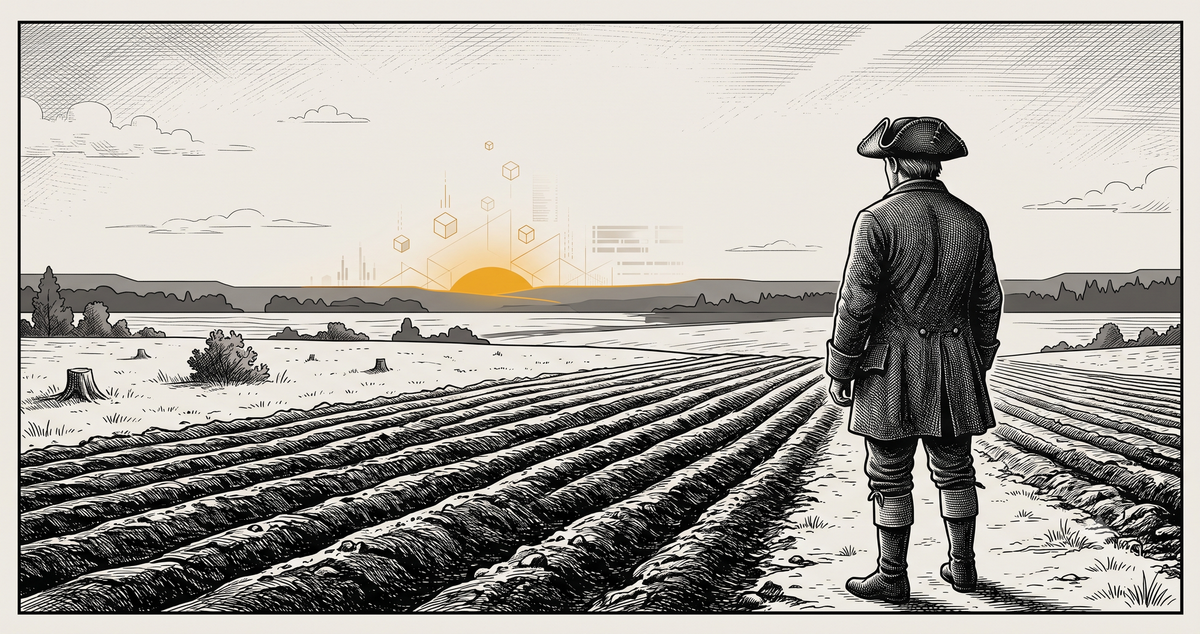
In 1790, the United States conducted its first census. Just under four million people. Nine out of ten of them worked a farm.
Now run a thought experiment with me. Walk up to one of those farmers — a man who measures wealth in acres, hogs, and how many of his children survived the winter — and tell him that in a couple of centuries, his descendants will earn a living by filming themselves eating breakfast. Tell him strangers will pay to watch. Tell him this occupation will support tens of millions of Americans and move more money in a single year than the entire economy he knows.
He wouldn't laugh at you. Laughter requires a frame of reference. He would have no more capacity to imagine a "social media influencer" than to imagine the phone it's filmed on.
Hold onto that farmer. He is the most important person in the debate we're about to have.
The jobs no one can see
Here's what actually happened to him and his descendants. Farming went from 90 percent of American labor to under 2 percent today. Ninety percent of the workforce, displaced — the largest occupational extinction in our history.
And no commission planned the replacement. No fund was seized to cushion the transition. Nobody in 1790, 1890, or 1990 could have named the jobs that would absorb those people, because the jobs didn't exist yet, and the things that would create them didn't exist yet either. Machinist. Electrician. Radiologist. Software engineer. Podcast producer. Each one invisible right up until the moment it wasn't.
The influencer isn't a punchline. It's the latest data point in the most consistent pattern in American economic history. Roughly 45 million Americans now identify as professional content creators. Influencer marketing alone was a $32 billion industry last year. The entire job category is younger than the iPhone.
I want to be precise about what this pattern proves, because it's stronger than the usual "markets are efficient" argument. It proves something about knowledge. New work is invisible before it exists. Not hard to predict — impossible to predict, for anyone, every single time. Which means any plan to manage a technological transition from the top is a plan built on knowledge that no planner has ever possessed.
Keep that in mind, because the plans are already arriving.
The reflex
Every technological revolution produces the same political reflex, and this one is producing it right on schedule. Universal basic income. Robot taxes. Government equity stakes in the companies building the technology. As I write this, the most ambitious version yet sits in the United States Senate: a proposal to take — not buy, take — half the stock of America's leading AI companies and place it in a federal fund run by political appointees, with board seats and voting power attached.
Disclosure, as always: I'm an investor in Anthropic, one of the companies these proposals name. Weigh my words accordingly.
I'm not going to spend much time on that bill, because the bill isn't the point. Its specifics will be forgotten in a few years. The reflex behind it is permanent. It has appeared in every transition since the loom, it will return in a new costume every session of Congress for the rest of our lives, and it deserves an answer at the level it's actually operating on.
Here's what I won't do: I won't pretend the fear behind it is stupid. It isn't. The concern driving all of this is valid. The pace of this revolution is unlike anything any of us has worked through — I say that as someone who builds with this technology every day — and people are genuinely fearful for their livelihoods. AI is trained on the accumulated output of humanity. The gains, so far, are concentrating in remarkably few hands. I hear the anxiety in nearly every conversation I have with business owners. The grievance and the fear are real.
But seize-and-manage is a princples-level error. Not a bad policy — a wrong answer to the oldest question we've ever asked ourselves as a country.
This is a principles question, not a policy question
Two weeks ago I wrote about the federal government switching off the most capable AI model ever released to the public — no law, no court, a letter on a Friday evening. My argument then was that whoever holds the kill switch holds the boundaries of acceptable thought.
Understand what government ownership does: it takes the hand holding the kill switch and puts an equity stake in it.
A government that owns the major AI companies is not a referee. It's a player — the biggest player — with board seats, voting shares, and a handful of political appointees deciding which corporate decisions serve the public. It regulates the companies it owns, taxes the companies it owns, investigates the companies it owns, and profits from the companies it owns. Every one of those functions corrupts the others. And when that same government decides a model is dangerous, or inconvenient, or asking the wrong questions — and we now know it will — there is no independent party left in the room. The player, the referee, and the league commissioner are the same people.
How does a free press work when it's powered by AI that won't touch certain topics?
The founders had a word for the fusion of political power and economic power. They'd just fought a war against it.
They were not anarchists, and neither am I. Madison put it exactly right:
"It has been said that all Government is an evil. It would be more proper to say that the necessity of any Government is a misfortune. This necessity however exists; and the problem to be solved is, not what form of Government is perfect, but which of the forms is least imperfect." — James Madison, 1833
Government is necessary. National defense, courts, enforcing contracts, pricing the externalities markets miss. The founding insight was never "no government." It was that government is a cost — a necessary misfortune — and every expansion of it should be treated the way you'd treat any cost: skeptically, and with a hard look at what it crowds out.
What it crowds out, first, is people's own capacity. Franklin, from his travels:
"In my youth, I traveled much, and I observed in different countries, that the more public provisions were made for the poor, the less they provided for themselves, and of course became poorer. And, on the contrary, the less was done for them, the more they did for themselves, and became richer." — Benjamin Franklin, 1766
And Jefferson, writing in 1816, named the mechanism — and notice the phrase, because it could have been written about this bill:
"We must make our election between economy and liberty, or profusion and servitude... If we can prevent the government from wasting the labours of the people, under the pretence of taking care of them, they would be happy." — Thomas Jefferson to Samuel Kercheval, 1816
Under the pretence of taking care of them. A dividend check, in exchange for the state owning the commanding heights of the most important technology in human history. That is always the trade on the table, whatever this year's asking price. Franklin and Jefferson would have recognized it instantly.
What I know firsthand
This is the part where I stop quoting dead men and tell you what I've lived.
In 2012 I started InductiveHealth. Our business, in many respects, competed directly with existing functions of state government. They had a mandate — a genuinely important one — to securely receive and process electronic health data to detect and respond to infectious disease outbreaks. Most did it poorly, and spent enormous sums doing it. Not because they were bad people. They weren't - many were excellent at understanding the tech and mission. As Elon has quipped, they were good people running on a bad organizational operating system.
The business we built delivered better mission outcomes — better data, more timely, more secure, more complete, more accurate — at an order of magnitude less cost. Sometimes more than an order of magnitude. And we made a profit doing it. A far larger profit, as a percentage, than our peers in government services.
Our services save lives. Better data in the hands of policy makers when an outbreak starts. Better information reaching the public in time to act on it. My "selfish" pursuit of profit produced value for our clients and their stakeholders far beyond what we charged. That's why they chose us — nobody was compelled to. In a free market, anyone can walk up and compete to serve others better, and the profit is the scoreboard telling you whether you actually did.
So let me ask the question that I think cuts through most of this debate: would it have been more virtuous to forego the profit and never build InductiveHealth at all? How many people would have needlessly gotten sick — how many would have died — waiting on data that arrived late, incomplete, or not at all?
Profit earned by serving people who freely chose you isn't a tax on virtue. In a free market, it's the evidence of it.
The honest ledger
Are all businesses so virtuous? No. Casinos exist. So do payday lenders and a hundred other enterprises I wouldn't build. But notice what every one of them has in common: somewhere, a person freely chose to spend their own money there. They got something they valued — entertainment, liquidity, hope, whatever it was. If that troubles us, and sometimes it should, it says more about us as customers than about markets as a system. The market is a mirror. Smashing the mirror doesn't fix the face.
But here's the pattern I find far more damning, and almost nobody talks about it: the industries where markets look their worst are precisely the ones where government involvement runs thickest.
Everyone's least favorite companies — the cable company, the phone company — operate inside dense regulatory thickets, franchise regimes, and permitting gauntlets that function, in practice, as government-built moats around incumbents. That's why expensive mediocrity dominates those sectors. Google, one of the most capable and best-capitalized companies on Earth, tried to bring fiber to American homes and got ground down city by city in the trench-permit wars. And observe how the only genuinely new entrant in a generation finally arrived: from space. Starlink — now past ten million subscribers, doubling year over year — because low Earth orbit was the one place the thicket didn't reach.
Healthcare is worse. I spent my career in that industry before Inductive, and I'll say it plainly: the single biggest impediment to lower costs and better outcomes in American healthcare is not greed, not technology, not complexity. It is the sheer mass of regulation and government entanglement in what we generously still call a "private" market.
So when someone points at a dysfunctional industry as proof that we need more government in the AI economy, check the ledger first. In my experience, you'll usually find government already there — holding the door shut.
The safety net and the hammock
None of this means we shrug at the people caught in the transition. The fear deserves a real answer — and here's what gets lost in the noise: America already built one. We have robust unemployment insurance in every state, designed precisely for this moment — for the worker displaced by forces beyond their control, carrying them while they find their footing in whatever comes next. That system has seen this country through farm mechanization, deindustrialization, offshoring, and the internet. It is a safety net. It was never meant to be a hammock.
And I can tell you something about the hammock, because I've earned one. After my exit, nobody would have blamed me for spending the rest of my days at the lake. I tried it. I can report back: it's not where happiness lives.
The research on human fulfillment has converged on something the founders seemed to know in their bones: we are happiest when we're making measurable progress against objectives that matter to us. Not when we're provided for — when we're building. Creating value for other people isn't just good for those recieving it, or for society. It is, reliably, the thing that makes the creator's own life feel worth living. A dividend check can cover your expenses. It cannot cover your purpose.
Which is why the founders never promised happiness. Read the words again: life, liberty, and the pursuit of happiness. They guaranteed the chase, not the catch — because they understood the chase is the point.
The bet
This week, the country turns 250.
Here is the fact I want you to sit with on the Fourth: the United States holds about 4 percent of the world's population and produces roughly a quarter of its economic output. That is not a rounding error. That is the most extraordinary economic outlier in recorded history, and it was not produced by a plan. No fund. No commission. No seven wise appointees.
It was produced by an operating condition. We called it freedom, and we bet the whole country on it: that free people, left room to build, would find ways to create value for each other that no one — no king, no commissar, no senator — could have specified in advance. The farmer couldn't see the influencer. The telegraph operator couldn't see the podcaster. And none of us, right now, can see the jobs the AI economy will create. That's not a bug in the system. That has always been how the system works.
Every previous transition, someone stood up and said: this time is different, this time the work runs out, this time we must seize and manage and provide. Every time, they were offering servitude priced as care. And every time, the pattern held — because human wants are inexhaustible, and free people are endlessly inventive at serving them.
I'm not asking anyone to ignore the disruption coming. I'm building my company because of it — I believe the leverage of this technology should belong to the independent economy, to the owner-operators, not exclusively to a few giants or, God forbid, to the state. Arming free people for the transition is the answer. Nationalizing the transition is the surrender.
To everyone reaching for that lever — and they will keep reaching for it, from both parties, for the rest of our lives — the grievance is real. The people you're worried about are the people I talk to every day. But you're proposing to protect them from the one force that has never failed them in 250 years — and hand their future to the one institution that can switch off the future by letter, on a Friday, without a vote.
Let's unleash our creativity to build value for each other. Let's remember what made us who we are. Two hundred fifty years in, freedom remains the operating system. Everything else is an application.
Happy Independence Day.
— Matt
Sources: U.S. Census (1790) and USDA historical labor data · BLS/World Bank on agricultural employment today · the American AI Sovereign Wealth Fund Act (introduced June 2026) · Goldman Sachs / Linktree creator-economy research · IMF/StatisticsTimes on U.S. share of global GDP · SpaceX subscriber disclosures · Franklin, "On the Price of Corn and Management of the Poor" (1766) · Jefferson to Samuel Kercheval (1816) · Madison, writings on majority governments (1833).